
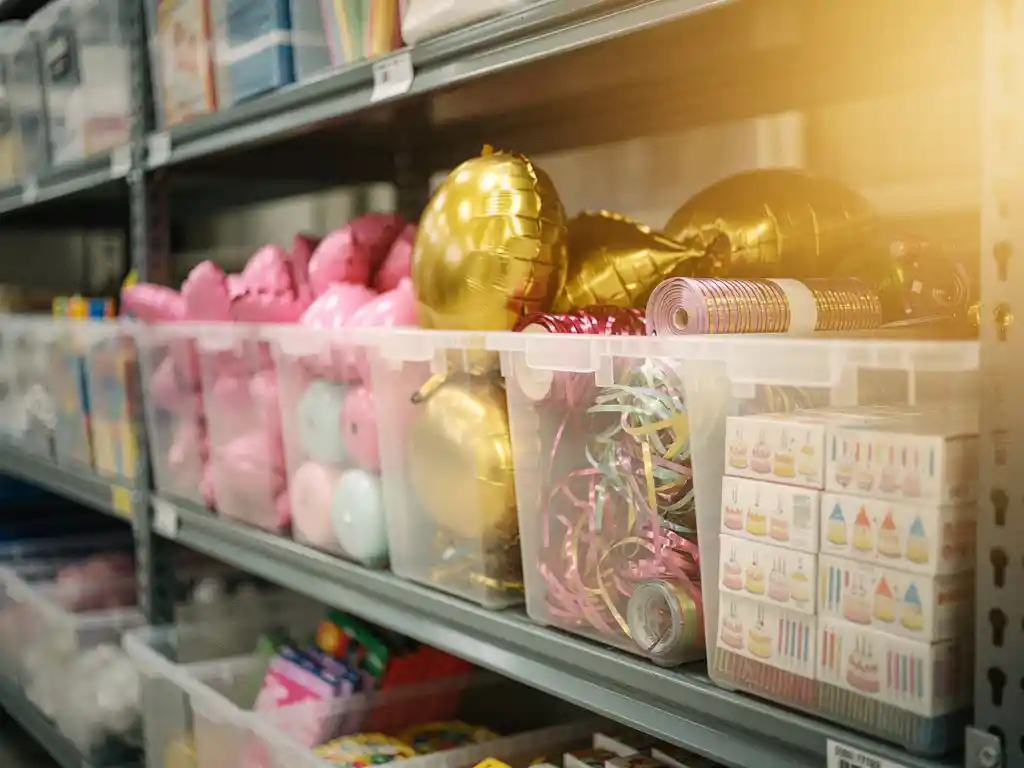

After a birthday celebration wraps up, you are often left with a mix of used and unused birthday party products that deserve a second life. Whether you are a professional event decorator, a party supplies retailer, or simply someone who bought in bulk, knowing how to store leftover supplies correctly can save you money, reduce waste, and keep your inventory in top condition for the next occasion.
The difference between supplies that look brand new six months later and those that end up in the bin often comes down to how they were stored immediately after the event. This guide walks you through the most important storage decisions, common mistakes to avoid, and clear guidance on when it is simply better to let go.
Why should you store leftover birthday party products properly?
Storing leftover birthday party products properly protects your investment, maintains product quality, and reduces unnecessary waste. Party supplies such as balloons, decorations, candles, and tableware can degrade quickly when exposed to heat, humidity, or direct sunlight. Correct storage extends their usable life significantly and ensures they perform as expected at the next event.
For professionals who purchase party supplies in bulk, proper storage is especially important. A damaged batch of balloons or a set of warped paper decorations is not just a cosmetic issue. It represents a direct financial loss. Good storage habits also make restocking more efficient, since you always have a clear picture of what is still usable and what needs replacing.
How do you store leftover latex and foil balloons?
Leftover latex and foil balloons should be stored in a cool, dark, and dry environment, away from direct sunlight, heat sources, and sharp objects. Latex balloons are particularly sensitive to temperature fluctuations and UV exposure, which cause them to oxidise, lose elasticity, and break more easily when inflated.
Storing uninflated latex balloons
Keep uninflated latex balloons in their original packaging where possible, or seal them in an airtight bag. Store them flat rather than folded to avoid crease marks that can weaken the material. A consistent room temperature between 15 and 20 degrees Celsius is ideal. Avoid storing them near ozone-generating equipment such as fluorescent lights or electric motors, as ozone accelerates latex degradation.
Storing foil balloons
Foil balloons are more durable than latex but still require careful handling. If they are partially inflated, gently press out the air before folding them along their original seam lines. Store them flat in a dry location. Avoid stacking heavy items on top, as creases in the foil can create weak points that cause the balloon to lose helium more rapidly when reinflated.
What are the best ways to store paper and fabric party decorations?
Paper and fabric party decorations should be stored flat or loosely rolled, in acid-free containers or sealed bags, in a dry location away from moisture and light. Humidity is the primary enemy of paper decorations, causing warping, mould, and colour bleeding. Fabric items such as banners and bunting can be folded gently and stored in breathable fabric bags to prevent musty odours.
For items like paper garlands, honeycomb balls, and tissue pom-poms, avoid compressing them tightly, as this can permanently distort their shape. If the original packaging is still intact, reuse it. Manufacturers design it specifically to maintain the product’s form during storage. Label each container clearly with the decoration type and colour theme so you can retrieve items quickly before the next event.
Should you store candles and small party accessories separately?
Yes, candles and small party accessories should be stored separately from other party supplies. Candles can transfer wax residue or fragrance onto surrounding items, and their wicks can become bent or broken if stored under pressure. Small accessories such as cake toppers, confetti, and party blowers are easy to lose or damage when mixed together in a single storage box.
Use small, labelled compartment boxes or zip-lock bags to organise accessories by type. Store candles upright in a cool location to prevent warping, particularly taper candles and shaped birthday candles that can bend in warm environments. Keeping categories separate also speeds up preparation for future events, as you can locate exactly what you need without sorting through a jumbled collection.
What storage mistakes cause party products to get damaged?
The most common storage mistakes that damage birthday party products include exposure to heat and sunlight, storing items in damp environments, and using inadequate containers that allow moisture or pests to enter. These errors are easily avoidable with a few straightforward precautions.
- Heat exposure: Garages, attics, and cars can reach very high temperatures in summer, which can melt candles, degrade latex, and warp plastic accessories.
- Moisture and humidity: Basements and outdoor storage units often have high humidity levels that cause paper goods to warp and metal accessories to rust.
- Overpacking boxes: Stuffing too many items into a single box crushes delicate decorations and causes balloons to develop weak spots.
- No labelling: Unlabelled storage makes it difficult to find items quickly and increases the chance of accidentally discarding usable supplies.
- Storing near strong odours: Latex and fabric items can absorb smells from cleaning products, paint, or food stored nearby, which can make them unsuitable for use at future events.
When is it better to discard leftover party supplies than store them?
It is better to discard leftover party supplies when they are visibly damaged, have exceeded their recommended shelf life, or are tied to a theme so specific that reuse is unlikely. Storing items that will never realistically be used again simply creates clutter and takes up valuable space that could hold genuinely reusable stock.
Latex balloons that have already begun to oxidise or feel brittle should be discarded rather than stored, as they are likely to break during inflation. Single-use items such as paper plates, napkins, and plastic cups that have been opened but not used can be stored briefly, but their hygiene and structural integrity decline over time. If a decoration is tied to a very specific event theme, for example a personalised banner with a child’s name and age, it is rarely worth the storage space.
How Globos Europe helps you manage birthday party products
At Globos Europe, we understand that smart purchasing and smart storage go hand in hand. As a B2B wholesale specialist in party supplies, we help decorators, retailers, and event professionals build an inventory that is easy to manage, high in quality, and built to last. Here is what we offer to support your needs:
- A wide range of latex and foil balloons, including our own We Fiesta brand, which meets the Toy Safety Directive 2009/48/EC and is fully biodegradable.
- Bulk purchasing options that make it easier to buy the right quantities and reduce excess stock.
- Compostable and FSC-certified products for businesses with sustainability goals.
- Private label options for retailers who want their own branded party supply range.
- A broad assortment of birthday party accessories, decorations, and tableware designed with quality and reusability in mind.
Whether you are looking to refresh your stock or plan ahead for the next season, visit Globos Europe to explore our full wholesale range and find the birthday party products that work best for your business.
Frequently Asked Questions
How long can you realistically store uninflated latex balloons before they go bad?
Uninflated latex balloons typically have a shelf life of 12 to 24 months when stored correctly in a cool, dark, and dry environment between 15 and 20°C. However, this can vary depending on the brand and latex quality — premium balloons like those meeting the Toy Safety Directive tend to hold up better over time. Always inspect stored balloons before use by gently stretching a small section; if the latex feels brittle, sticky, or shows discolouration, it is safer to replace them rather than risk breakage during inflation.
What is the best type of container to use for storing mixed party decorations?
Clear, airtight plastic storage bins are the most practical option for most party decorations, as they protect against moisture and pests while allowing you to see the contents at a glance. For more delicate paper items like honeycomb balls or tissue pom-poms, acid-free boxes or archival-quality containers offer added protection against yellowing and degradation. Avoid cardboard boxes for long-term storage, especially in garages or basements, as they absorb moisture and can attract insects.
Can foil balloons be reinflated after being stored, and will they hold helium as well as new ones?
Yes, foil balloons can generally be reinflated after proper storage, provided they were deflated carefully along their original seam lines and stored flat without heavy items pressing down on them. Most quality foil balloons have a self-sealing valve that remains functional through multiple inflation cycles. That said, any creases or fold lines in the foil can create micro-tears that cause faster helium loss, so always inspect stored foil balloons carefully before reinflating them for a paid event or display.
Is it worth investing in vacuum storage bags for party supplies to save space?
Vacuum storage bags can be useful for fabric items like bunting, fabric banners, and soft decorations, where space saving is a priority and compression will not damage the item. However, they are not suitable for paper decorations, balloons, or anything with a three-dimensional shape, as the pressure will permanently distort or damage these products. For bulk party supply businesses, a better space-saving strategy is to standardise container sizes and stack them on shelving units, which keeps items accessible and organised without risking damage.
How should I organise my storage system if I manage party supplies for multiple upcoming events?
The most efficient approach is to organise your storage by product category first (balloons, tableware, decorations, candles, accessories) and then by colour or theme within each category. Use clearly labelled bins or shelving sections and maintain a simple inventory list — even a basic spreadsheet — so you know exactly what you have in stock before placing new orders. This system prevents duplicate purchasing, speeds up event preparation, and helps you identify which items need replenishing at a glance.
What should I do with leftover party supplies that are still in good condition but I know I will not reuse?
Rather than discarding usable supplies, consider donating them to local schools, community centres, children's charities, or community event organisers who regularly host celebrations on tight budgets. For businesses, returning unopened stock to your supplier or offering it as part of a clearance bundle to customers can recover some of the cost. If the items are genuinely single-use or non-recyclable, check your local council's waste guidelines — some paper and biodegradable products can be composted rather than sent to landfill.
Are there any party products that simply should not be stored and should always be purchased fresh?
Yes — certain products are best purchased fresh for each event rather than stored. These include pre-filled confetti balloons (the latex degrades around the confetti over time), scented candles (which lose fragrance potency and can transfer scent to other stored items), and any opened packs of paper plates, napkins, or cups, which can absorb odours and lose their structural integrity. For professional event decorators and retailers, it is more cost-effective to buy these items in accurate quantities per event rather than holding excess stock.
Related Articles
- What birthday party products are essential for a kids’ party?
- Are wholesale balloons safe for children’s events?
- How do you choose the right party products wholesale distributor?
- What is the difference between party products wholesale and a party supply franchise?
- What birthday party products are hardest to find in local stores?