
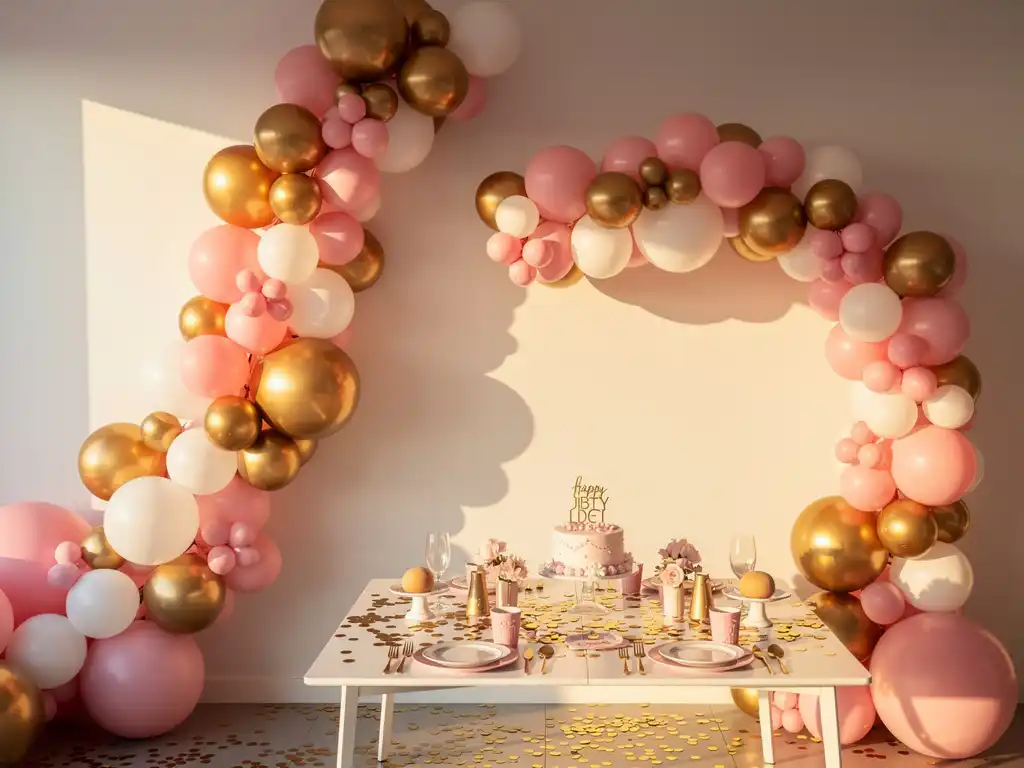

Balloon garlands and balloon arches are two distinct decoration styles used for birthday parties. A balloon garland is a flexible, organic cluster of balloons arranged along a surface or hung as a backdrop. A balloon arch is a freestanding or anchored curved structure that frames an entrance or focal point. Both create visual impact, but they differ in shape, setup, and where they work best.
Choosing the wrong balloon structure wastes money and setup time
Many people buy balloons for a birthday party without a clear plan, then spend twice as long setting up because the structure does not suit the space. An arch set up in a small living room can overwhelm the room, while a garland strung across an outdoor entrance can look flat and get lost in the open space. Knowing which structure fits your venue before you buy saves both money and frustration. The fix is simple: decide on your focal point first, measure the space, and then choose the balloon format that naturally fits the location.
Mismatched balloon quantities can ruin your decoration before guests arrive
Balloon garlands and arches require very different quantities of balloons, and underestimating this is one of the most common mistakes in party planning. A full balloon arch covering a doorframe typically needs far more balloons than a garland covering the same visual width because the arch requires balloons packed tightly on all sides of a three-dimensional curve. Running short on balloons mid-setup means gaps, uneven coverage, and a finished result that looks incomplete. Before purchasing, sketch out your structure, estimate the balloon count generously, and always order more than you think you need. At Globos Europe, we supply balloons in wholesale quantities, so you always have enough to work with.
What is a balloon garland, and how is it used for birthday decorations?
A balloon garland is a string of balloons clustered together in varying sizes and colors to create a flowing, organic shape. It is typically attached to a wall, draped along a table, or used as a photo backdrop. For birthday decorations, garlands add a layered, textured look that works well in indoor spaces and can be customized to match any color theme.
Unlike rigid structures, a balloon garland follows the contours of whatever surface it is placed against. This makes it highly adaptable. You can drape it along a dessert table, frame a doorway, or create a full wall installation behind a birthday cake. The organic, asymmetrical style of a garland has become very popular for birthday parties because it photographs well and feels less formal than a traditional arch.
Garlands are typically built by inflating balloons in different sizes, then attaching them to a balloon decorating strip or tying them directly to fishing line or string. Smaller balloons fill the gaps between larger ones, creating the dense, cloud-like texture that defines the garland look.
What is a balloon arch, and what makes it different from other balloon structures?
A balloon arch is a curved or semicircular structure made from balloons attached to a frame or line that forms a defined arc shape. It stands apart from other balloon structures because of its symmetrical, framed appearance and its function as an entrance feature or stage focal point. Arches are freestanding or anchored at both ends to create a gateway effect.
There are several types of balloon arches. An organic arch uses balloons of different sizes packed tightly together without a rigid frame, giving a more natural look similar to a garland but shaped into a curve. A classic column arch uses uniform balloons attached to a metal or PVC frame in a spiral or grid pattern for a more structured, formal finish.
Balloon arches are a strong choice when you want to define a specific spot, such as a party entrance, a photo booth, or a stage backdrop. They create a clear visual anchor that draws guests toward a particular area, which is why they are commonly used for milestone birthday celebrations and events where a grand entrance matters.
What are the main differences between balloon garlands and balloon arches?
The key differences between balloon garlands and balloon arches are shape, structure, and placement. A garland is flexible and surface-mounted, designed to follow a wall or table edge. An arch is curved and freestanding or anchored at two points, designed to frame a space. Garlands work best as backgrounds; arches work best as entrances or focal points.
Here is a direct comparison of the two:
- Shape: Garlands are linear and flowing; arches are curved and symmetrical.
- Support: Garlands attach to walls, ceilings, or furniture; arches need anchor points at both ends or a frame.
- Style: Garlands tend to look organic and layered; arches look structured and formal.
- Use case: Garlands suit backdrops, table edges, and wall displays; arches suit entrances, stages, and photo opportunities.
- Balloon count: Arches generally require more balloons than a garland of similar visual width.
Neither is objectively better for birthday decorations. The right choice depends on your space, your theme, and the effect you want to create.
Which is easier to set up — a balloon garland or a balloon arch?
A balloon garland is generally easier to set up than a balloon arch. Garlands do not require a freestanding frame, and their organic shape means small imperfections are barely noticeable. An arch requires more precise balloon placement to maintain its curve and symmetry, and setting up a frame-based arch adds extra steps and equipment.
For someone decorating a birthday party without professional experience, a garland is the more forgiving option. You inflate balloons in a range of sizes, attach them to a decorating strip or string, and mount them to the wall with hooks or tape. The process is straightforward and can be done in stages, even the day before the party.
An organic balloon arch without a rigid frame is a middle-ground option. It requires more balloons and more careful shaping than a garland, but it avoids the complexity of assembling a metal or PVC frame. If you want an arch look without professional help, the organic style is the most accessible starting point.
What types of balloons work best for garlands and arches?
Latex balloons in a range of sizes work best for both garlands and arches. Sizes between 5 inches and 12 inches are the most commonly used, with smaller balloons filling gaps between larger ones to create density and texture. Foil balloons can be added as accent pieces but are not suitable as the primary building material because they do not cluster as naturally as latex.
For garlands, mixing at least three balloon sizes creates the layered, organic texture that makes the style visually interesting. Using only one size produces a flat, uniform look that lacks depth. A typical garland uses a combination of 5-inch, 10-inch, and 12-inch latex balloons.
For arches, consistency in sizing matters more than it does for garlands, especially for classic column-style arches where uniformity is part of the design. Organic arches follow the same multi-size principle as garlands. In both cases, using high-quality latex balloons ensures the structure holds its shape throughout the event without deflating prematurely. Balloons that are too thin or poorly made will shrink within hours, leaving gaps in your decoration.
Should you choose a balloon garland or a balloon arch for a birthday party?
Choose a balloon garland if you want a versatile, easy-to-install decoration that works as a backdrop or table display. Choose a balloon arch if you want to frame an entrance or create a clear focal point for photos. For most indoor birthday parties, a garland offers more flexibility. For milestone events or parties with a defined entrance, an arch makes a stronger visual statement.
Consider these factors before deciding:
- Space: Small or low-ceilinged rooms suit garlands better; larger venues with defined entrances suit arches.
- Budget: Garlands typically require fewer balloons and no frame, making them more cost-effective.
- Skill level: Garlands are more beginner-friendly; arches require more planning and precision.
- Theme: Organic, relaxed themes suit garlands; formal or grand themes suit arches.
- Photography: Both work well as photo backdrops, but arches create a natural framing effect that garlands do not.
Many party decorators use both together, placing an arch at the entrance and a garland behind the dessert table. This combination covers multiple areas and creates a cohesive decoration scheme throughout the venue.
How We Help You Create Stunning Birthday Decorations
At Globos Europe, we supply the balloons and accessories you need to build both garlands and arches with confidence. Whether you are decorating a small birthday gathering or a large milestone event, we offer:
- Latex balloons in multiple sizes, including 5-inch, 10-inch, and 12-inch options for layered garland and arch builds
- Foil balloons and number balloons to use as accent pieces within your structure
- Balloon decorating strips and accessories to make assembly faster and more professional
- Products under our own We Fiesta brand, with high-quality, biodegradable latex balloons that meet the Toy Safety Directive 2009/48/EC
- Wholesale quantities so you always have enough balloons to complete your decoration without running short mid-setup
We work with decorators, party stores, and event professionals across Europe. If you want to stock up on balloon supplies for birthday decorations or explore our full range, visit Globos Europe to see what we offer.
Frequently Asked Questions
How do I calculate exactly how many balloons I need for a garland or arch?
A general rule of thumb is to plan for approximately 12–15 balloons per foot (30 cm) of garland, depending on how densely packed you want the finish. For arches, multiply that number by 1.5 to 2 times, since the three-dimensional curve requires coverage on all sides. Always add a 10–15% buffer to your total count to account for popped balloons during inflation and any gaps you need to fill during assembly.
Can I build a balloon garland or arch the day before the party?
Yes, but with some precautions. Air-filled latex balloons hold their size for 1–3 days, making them suitable for same-day or next-day setups. Helium-filled latex balloons, however, begin to shrink within 8–12 hours, so those should be inflated as close to the event as possible. If you are building your structure the day before, use air inflation and store the finished decoration in a cool, dry room away from direct sunlight or sharp objects.
What tools and supplies do I actually need to build a balloon garland at home?
The core supplies are latex balloons in at least three sizes, a balloon decorating strip (a plastic strip with pre-punched holes), a hand pump or electric balloon inflator, and removable adhesive hooks or wall-safe tape for mounting. Fishing line or twine can substitute for a decorating strip if needed. An electric inflator is highly recommended — inflating dozens of balloons by mouth is time-consuming and impractical for larger builds.
What is the most common mistake beginners make when building their first balloon arch?
The most common mistake is using balloons of only one size, which produces a flat, uniform structure that lacks the visual depth of a professional-looking arch. A strong arch — especially an organic one — relies on varied balloon sizes to create dimension and fill gaps naturally. A second frequent error is not securing the anchor points firmly enough before adding balloons, which causes the arch to shift or collapse under the weight of a fully loaded structure.
How do I keep my balloon garland or arch from deflating before the party ends?
Use high-quality latex balloons, as thinner or low-grade balloons lose air significantly faster. Avoid placing the structure near heat sources, direct sunlight, or air conditioning vents, all of which accelerate deflation. If your event runs longer than four hours, consider using Hi-Float treatment inside each balloon before inflation, which creates an internal coating that dramatically extends the life of air-filled latex balloons.
Can balloon garlands and arches be used for outdoor birthday parties?
Yes, but outdoor conditions require extra planning. Wind is the biggest challenge — secure your structure with multiple anchor points and use weighted bases for arches rather than relying solely on ground stakes. Avoid setting up too far in advance outdoors, as UV exposure and temperature changes cause latex balloons to degrade and pop faster than in indoor conditions. For outdoor events, slightly under-inflating your balloons by about 10–15% gives them more tolerance against heat expansion and wind stress.
Is it possible to reuse a balloon garland or arch for a second event?
Partially, yes. The hardware — decorating strips, frames, fishing line, and anchor fittings — can absolutely be reused. The balloons themselves, however, are single-use; once inflated and deflated, latex balloons lose elasticity and will not re-inflate evenly or hold their shape reliably. If you are planning multiple events, invest in reusable frames and accessories, and simply budget for fresh balloons each time to ensure a clean, professional finish.